Colorado needs about 30,600 additional homes a year through 2036 to accommodate projected household growth, according to the state's first statewide Housing Needs Assessment. The same report estimates that nearly 34% of households face housing costs above 30% of their income.
For Denver and the wider Front Range, the findings explain how falling apartment rents and high vacancy rates can coexist with widespread financial pressure. The supply of available homes, their prices and the incomes of the people seeking them each shape whether housing is affordable.
The Department of Local Affairs announced the assessment in a release dated Nov. 9. Follow-up reporting by KJCT and KKTV this week brought renewed attention to its findings. The November 2026 report combines housing-market indicators, Census survey data and State Demography Office estimates and forecasts.
Two housing needs to keep separate
The annual 30,600-unit figure covers expected growth in households from 2026 through 2036. The report divides that demand into approximately 19,900 owner units and 10,700 rental units each year.
It also estimates a current shortfall of about 106,000 homes associated with pent-up demand. That calculation considers how many more households would live independently if household-formation patterns resembled those in 2000.
Those figures answer different planning questions. The annual figure describes the pace needed for future growth. The shortfall describes an existing gap associated with people sharing housing who might otherwise form separate households.
The assessment says the current construction pace is sufficient to meet forecast growth. It also calls for more homes at prices lower- and middle-income households can afford, while warning that a further decline in construction could leave the state behind future demand.
What being cost-burdened means
The report defines a household as cost-burdened when it spends more than 30% of household income on housing costs, including utilities. Spending more than 50% meets its definition of severe cost burden.
The assessment puts the statewide share near 34%, including roughly half of renter households and about a quarter of owner households. That pressure can leave less money for food, health care and other needs.
These are estimates built from multiple years of evidence. The report's affordability projections use household and tenure forecasts alongside average 2022-2024 American Community Survey shares by income group. Readers should distinguish those modeled 2026 estimates from individual household bills or a new survey taken this month.
The Front Range has its own pattern
The assessment groups Colorado into four broad regions. Region III follows the Front Range and includes 14 counties, a geography wider than Denver or the Denver metro housing market.
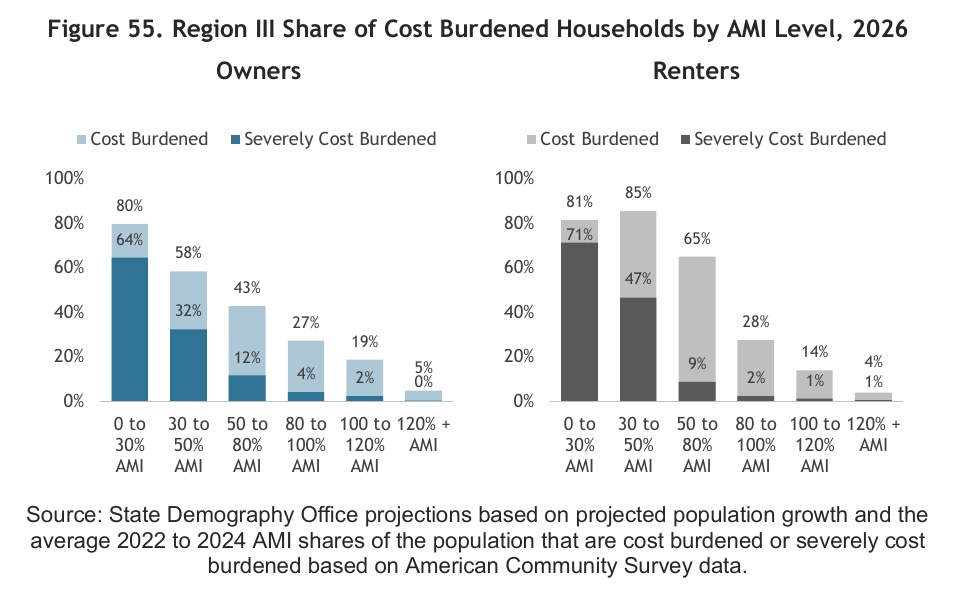
For that region, the report estimates about 717,800 cost-burdened households in 2026. Its apartment-market table lists a 9.7% vacancy rate and average rent of $1,755 in June 2026, with rent down 1.6% from a year earlier. Those are regional apartment-market figures for that period.
The report links the softer rental market to apartments delivered after a surge in construction. It also describes a sharp reduction in the construction pipeline, which can affect supply when projects already underway finish.
Lower-income renters remain especially exposed. The Region III analysis estimates that about 81% of renter households earning up to 30% of area median income are cost-burdened. Area median income, often shortened to AMI, groups households by income relative to their area's benchmark.
What the findings mean for a housing search
For a renter, regional vacancy and rent trends can be a reason to compare several buildings and the full cost of each lease. Utilities, required fees and the rent due after a concession ends all affect the monthly budget. A regional average can provide context, while an actual listing and lease provide the costs for a specific home.
For local housing plans, the report puts growth, household income and the price of new homes in the same frame. Matching construction to future population growth is one task. Expanding choices within the budgets of existing residents is another.
The full assessment includes regional chapters and methods that explain how the estimates were built. Its November publication date and the dates on individual tables are useful checks when comparing the findings with a current listing or another housing report.
Sources
- Colorado State Demography Office, Colorado Housing Needs Assessment, November 2026, printed pages 10-11, 85-87, 102-104, 127 and 134-138: Full report
- DOLA release dated November 9, 2026: Source
- KJCT, updated November 16, 2026: Source
- KKTV, November 16-17, 2026: Source